There are feelings people carry for years without ever learning how to describe them.
It may be the strange sadness of growing apart from someone who once felt inseparable. It may be the guilt that arrives when a person finally chooses something for themselves. It may be the loneliness of sitting in a crowded room while feeling completely unknown. Sometimes it is the quiet relief that follows the end of something once considered impossible to live without.
These experiences are familiar to many people, yet language often fails to capture them.
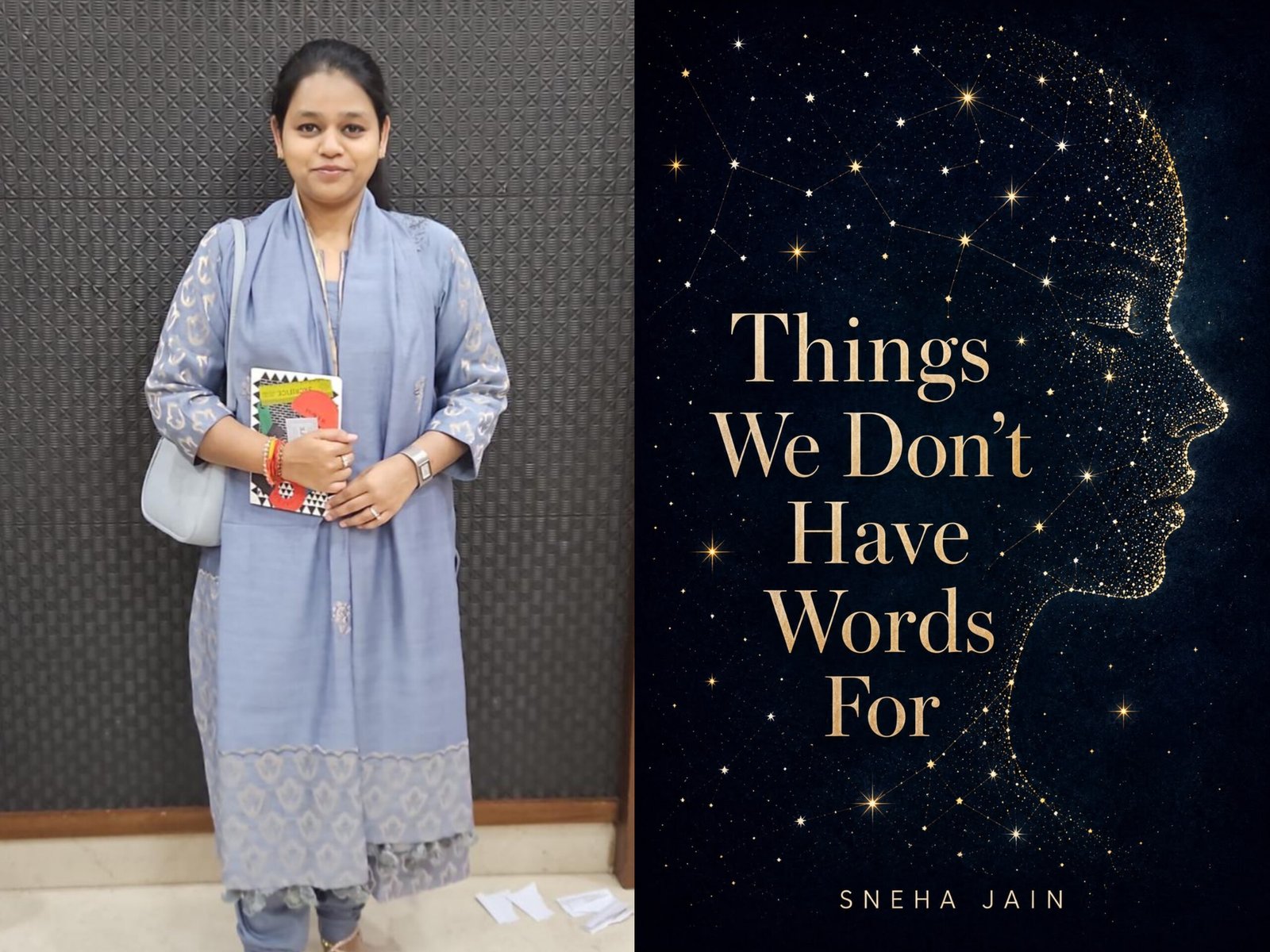
It is this space between emotion and expression that author Sneha Jain explores in her latest book, Things We Don’t Have Words For, a collection of 730 original emotional reflections that looks closely at the feelings that often remain unnamed.
Rather than attempting to provide simple answers to complicated emotional experiences, the book takes a different approach. It asks readers to pause.
The central idea is deceptively simple. What happens when a person knows exactly what they are feeling but cannot find the words to explain it?
For Sneha Jain, that question becomes the foundation of an entire literary experience.
Why Things We Don’t Have Words For Speaks to the Emotions We Cannot Explain
The book moves through love, loss, change, belonging, memory, identity, healing, ambition, hope, loneliness and relationships. Its reflections focus on the subtle emotional experiences that rarely fit comfortably into familiar categories such as happiness, sadness, anger or fear.
That makes Things We Don’t Have Words For particularly relevant to a generation increasingly willing to speak about emotions while still struggling to articulate them.
There is a significant difference between feeling something and being able to name it. The ability to recognise an emotion can change the way a person understands an experience. Jain’s writing operates within that delicate space.
The book does not tell readers what they should feel.
Instead, it invites them to recognise what they already feel.
That distinction is important.
Much contemporary writing around personal growth is built around advice, solutions and instructions. Things We Don’t Have Words For chooses reflection instead. Its purpose is not to dictate an emotional response but to create a quiet literary space in which readers can encounter their own thoughts.
Among its many subjects are the experiences that accompany personal change. Outgrowing people. Leaving behind older versions of oneself. Reconsidering relationships. Wanting something independently of other people’s expectations. Remembering who one used to be. Learning to let go.
These are not necessarily dramatic events.
Often, they happen quietly.
Yet quiet experiences can leave some of the deepest marks on a person’s inner life.
Sneha Jain’s 730 Reflections on Love, Loss, Identity and Human Connection
This is where the book’s 730 reflections become significant. Rather than presenting one continuous narrative, Jain creates a collection that readers can enter from different emotional points. A reader may open the book looking for an explanation of one particular feeling and unexpectedly find another reflection that speaks to something entirely different.
The appeal lies in recognition.
Sometimes the most powerful moment in reading is not discovering an answer. It is discovering that another person has experienced something remarkably close to what one has struggled to explain.
Sneha Jain’s background adds another dimension to this literary work. She is an author, counselling psychologist, mindset coach, motivational speaker and youth mentor whose work sits at the intersection of words, emotions and human connection.
She is also the author of 13 books exploring identity, resilience, relationships, women’s experiences and the quieter realities of being human.
Her professional work informs a perspective deeply concerned with how people understand themselves and their experiences. Her approach to counselling is informed by CBT, REBT and solution focused counselling, while her wider work includes mindset, personal growth and youth mentoring.
Yet Things We Don’t Have Words For is not presented as a counselling manual.
It is literature built around emotional recognition.
Jain’s belief that being understood can begin with finding the right words is at the heart of the book. That idea also explains why the collection reaches beyond conventional motivational writing. It does not demand transformation from the reader. It creates room for reflection.
For anyone who has ever said, “I don’t know how to explain what I’m feeling,” the book offers a starting point.
Not necessarily an answer.
A language.
And sometimes that is enough to begin understanding ourselves differently.
With Things We Don’t Have Words For, Sneha Jain turns the difficulty of expressing emotion into the subject of a deeply reflective literary collection. In doing so, she explores one of the most universal human experiences of all: knowing that something is happening inside us, long before we know what to call it.
Amazon Link: https://www.amazon.in/Things-We-Dont-Have-Words/dp/9379033621