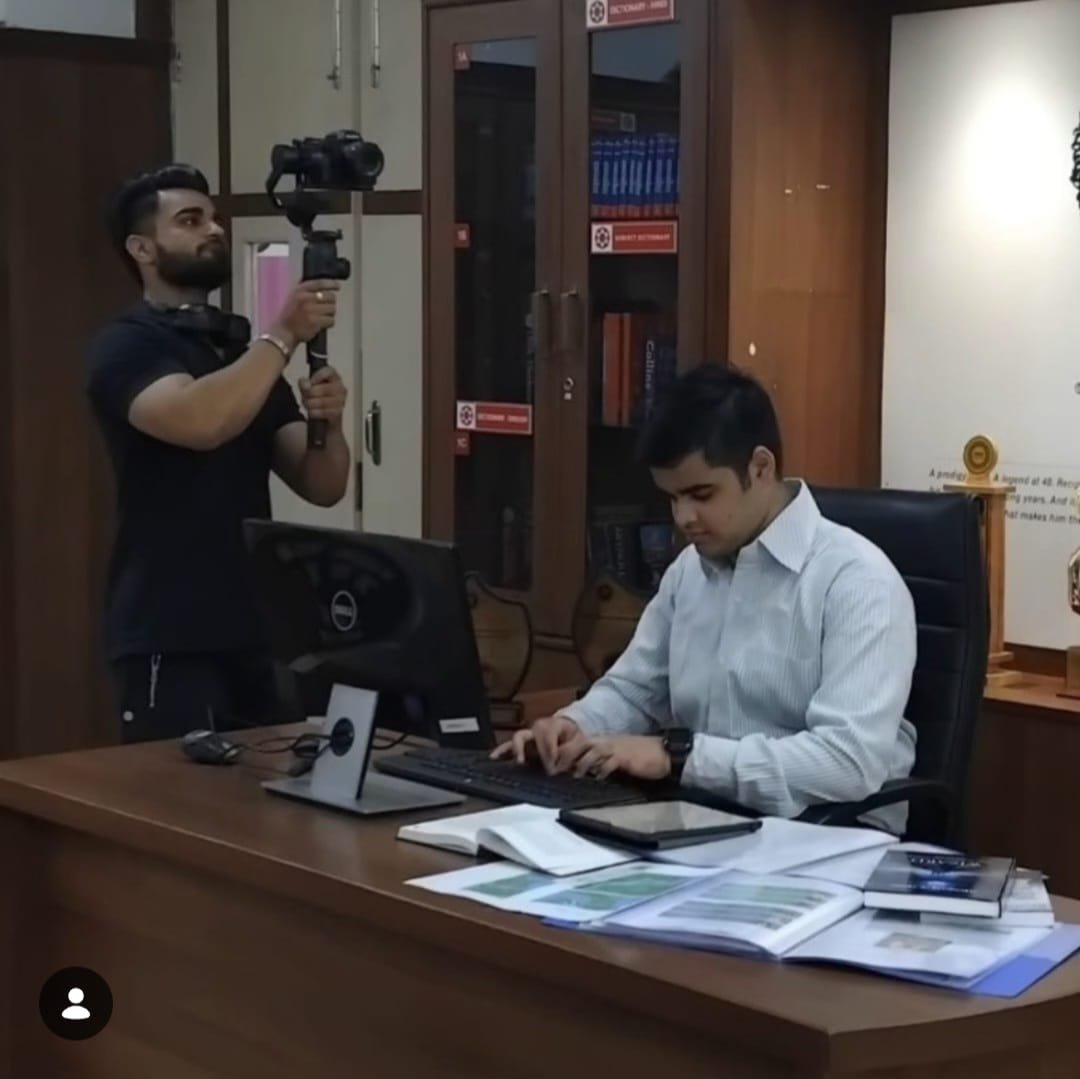
From imagining interconnected worlds and civilizations to developing an elaborate literary universe, the journey of recognized Polymath and Indian literary prodigy Manikya Sanghi raises fascinating questions about childhood creativity, multidisciplinary learning and the limitless possibilities of a curious mind.
At an age when most children are discovering the joys of reading and writing, nine-year-old Manikya Sanghi was undertaking an unusually ambitious creative endeavour: conceiving, developing and writing an elaborate, multi-world epic fiction series titled Chronicles of Tierra.
Beginning in 2017, Manikya’s creative vision extended beyond an ordinary children’s story. It involved interconnected worlds, distinct civilizations, elaborate histories, cosmic concepts, complex characters and overarching narrative structures. The scale of the undertaking raises an intriguing question: what kind of knowledge, imagination and intellectual abilities could enable a nine-year-old to conceptualise and develop a fictional universe of such magnitude?
Now 18, Manikya is an internationally recognised, award-winning Indian author and multidisciplinary achiever who is described as a modern polymath. His journey from child literary prodigy to a young personality working across literature, screenwriting, artificial intelligence, technology and other creative disciplines offers an interesting perspective on childhood learning and intellectual development.
However, understanding his literary accomplishment requires looking beyond his age. It calls for examining the different dimensions of knowledge and thinking that contribute to creating an interconnected epic.
The 12 Knowledge Domains Behind an Epic Fictional Universe
Developing a fictional universe on the scale of Chronicles of Tierra involves considerably more than inventing interesting characters or imagining extraordinary adventures. It requires the ability to connect different disciplines and maintain consistency across an expanding narrative.
Twelve knowledge domains are particularly relevant.
1. Worldbuilding and Systems Thinking
An elaborate fictional universe requires geographical structures, climates, natural resources, ecosystems, settlements and interconnected environments. More importantly, these elements must influence one another.
For instance, geography can determine migration patterns, trade relationships, political boundaries and military strategies. Understanding such connections enables an author to create worlds that feel coherent rather than like collections of unrelated imaginary locations.
2. History, Civilisations and Political Systems
Creating multiple societies across different historical periods involves understanding kingdoms, empires, dynasties, leadership, succession, alliances, revolutions and diplomacy.
A compelling fictional civilisation also needs a sense of historical continuity. Present-day conflicts become more meaningful when they emerge from earlier events, inherited rivalries or changing social structures.
3. Mythology, Religion and Cosmology
Creation stories, divine beings, prophecies, sacred traditions and competing explanations of existence add philosophical and symbolic dimensions to epic fiction.
An author must be able to imagine different systems of belief and understand how they influence the decisions, traditions and relationships of fictional societies.
4. Astronomy, Physics and Speculative Science
Stories involving planets, stars, dimensions, time, alternate realities and cosmic forces require a certain understanding of scientific principles and logical consistency.
Even when an author invents fictional laws of physics, those laws need to remain reasonably consistent. If time operates differently across two worlds, for example, the consequences for ageing, travel and historical events must be considered.
5. Psychology, Personality and Human Behaviour
Believable characters require an understanding of emotions, motivations, relationships and moral conflicts.
Fear, ambition, jealousy, loyalty, courage, grief and sacrifice can influence characters in different ways. Their experiences should shape their decisions and, ideally, transform them throughout the narrative.
6. Strategy, Conflict and Power Structures
Political struggles, wars, conspiracies and competing factions require strategic reasoning.
An author must consider the motivations, resources, limitations and objectives of different sides. The strongest conflicts often emerge when opposing characters or groups have understandable reasons for their actions.
7. Language, Linguistics and Naming Systems
Distinctive names, titles, terminology and expressions contribute to the identity of fictional worlds.
In more elaborate universes, an author may also develop linguistic conventions, writing systems or distinctive speech patterns. Maintaining consistency across multiple books is essential.
8. Literature, Narrative Structure and Storytelling
This is among the most important domains. Transforming imaginative concepts into an engaging literary work requires an understanding of plot development, pacing, dialogue, suspense, foreshadowing, symbolism, character arcs and resolution.
A multi-book series adds another challenge: each individual book must offer a satisfying narrative while contributing to a much larger story.
9. Mathematics, Chronology and Logical Consistency
Multiple worlds and extended timelines introduce questions of distance, age, generations, genealogies, calendars and the sequence of historical events.
Even without advanced mathematical knowledge, an author needs systematic thinking and the ability to identify contradictions.
10. Biology, Ecology and the Nature of Life
Imaginary creatures, unfamiliar species, magical beings and unusual ecosystems require biological imagination.
Concepts such as adaptation, reproduction, food chains, survival and interdependence help make fictional environments more convincing.
11. Philosophy, Ethics and Abstract Thinking
Themes such as good and evil, freedom, destiny, justice, identity, consciousness, mortality and the responsible use of power can give an epic intellectual depth.
Formal philosophical education is not necessarily required. However, observation, reflection and the ability to explore conflicting perspectives can help an author weave these questions naturally into a story.
12. Research, Synthesis and Creative Integration
Perhaps the most important capability is bringing knowledge from different areas together to create something original.
According to accounts of Manikya’s upbringing, three important influences contributed to his learning process: regular Sidhshakti Meditation from childhood under the guidance of his mentor, the internationally recognised spiritual scientist Sri Maa Sidh Sidhshakti Ji; interactions and learning experiences with people from diverse backgrounds and age groups; and practical observation of nature and everyday activities, including hands-on learning and building things under adult supervision.
These experiences, alongside reading and independent exploration, reportedly helped him develop an approach to learning that connected different subjects rather than treating them as isolated areas of knowledge.
Importantly, a child does not necessarily need advanced knowledge of all twelve domains to create an imaginative fictional universe. Intuition, observation, reading, experimentation and storytelling can also produce remarkable creative results.
Beyond Knowledge: The Intellectual Abilities That Make the Difference
Knowing about mythology, science, history or literature does not automatically translate into the ability to write a complex novel.
The creative process requires several complementary intellectual abilities.
For Manikya’s undertaking, these would include generative imagination to invent original worlds; abstract reasoning to understand hypothetical realities; systems thinking to connect different elements; working memory to track characters and events; long-range planning to develop interconnected books; cognitive flexibility to explore alternative possibilities; causal reasoning to construct meaningful consequences; verbal ability to express complex ideas; sustained attention to develop a substantial project; and self-monitoring to identify inconsistencies and improve the writing.
The distinction is significant. Imagining a fascinating world is one accomplishment. Building a coherent universe, developing its characters and histories, and translating it into an extended literary narrative is considerably more demanding.
Four Levels of Literary and Worldbuilding Achievement
The complexity of Chronicles of Tierra can be examined through four analytical levels.
- Level 1 – Original imaginative conception: Independently inventing the central universe, its characters, worlds and major conflicts.
- Level 2 – Structured worldbuilding: Establishing interconnected histories, societies, cultures and consistent fictional rules.
- Level 3 – Complex narrative construction: Developing multiple plotlines, character transformations, thematic depth and meaningful connections between books.
- Level 4 – Integrated epic architecture: Bringing metaphysics, timelines, civilisations, characters, conflicts and overarching themes together into a coherent fictional universe.
The claim associated with Manikya’s accomplishment is that Chronicles of Tierra reaches this fourth level and that he independently conceived and developed its underlying architecture at nine.
Ultimately, the literary significance of the series must also be considered in terms of originality, execution, narrative quality and the extent of independent authorship, rather than simply its length or the number of fictional worlds.
How Did Manikya Develop Such Abilities Without Formal Writing Training?
Manikya’s mother, Hon. Dr. Anjali Sanghi, an educational innovator, offers insights into the learning environment that supported his early development.
Recalling his childhood, she says:
“Manikya was often seen holding board books from the age of six months. As he grew, he developed a love for reading long and complex words. By the age of three, he had progressed to reading encyclopaedias. He developed not only a large vocabulary but also the curiosity to continually expand it.”
She explains that Manikya was encouraged to ask questions freely, regardless of how frequently he asked them. His exposure to traditional, ancient and contemporary storytelling, prose and poetry introduced him to different subjects and enriched his understanding of language.
Three aspects of his development particularly stand out.
A broad foundation of accumulated knowledge: Early exposure to books, storytelling, vocabulary and diverse subjects helped establish a foundation for independent learning.
Intuitive reasoning and inner development: According to his mother, Sidhshakti Meditation, spiritual practices, daily discipline, relaxation and a balanced lifestyle contributed to his intuitive thinking and personal development.
A structured creative process: Once Manikya conceived the overarching idea for Chronicles of Tierra, he reportedly began recording its details in notebooks. He subsequently developed the first novel chapter by chapter as an audio story. This was transcribed and accompanied by detailed notes, drawings, maps, character lists and costume designs. The material then underwent revisions before becoming printed books.
This process demonstrates an important distinction: an idea may emerge in a seemingly complete form, but transforming it into a finished literary series involves documentation, organisation, development and refinement.
Manikya’s Formal Education
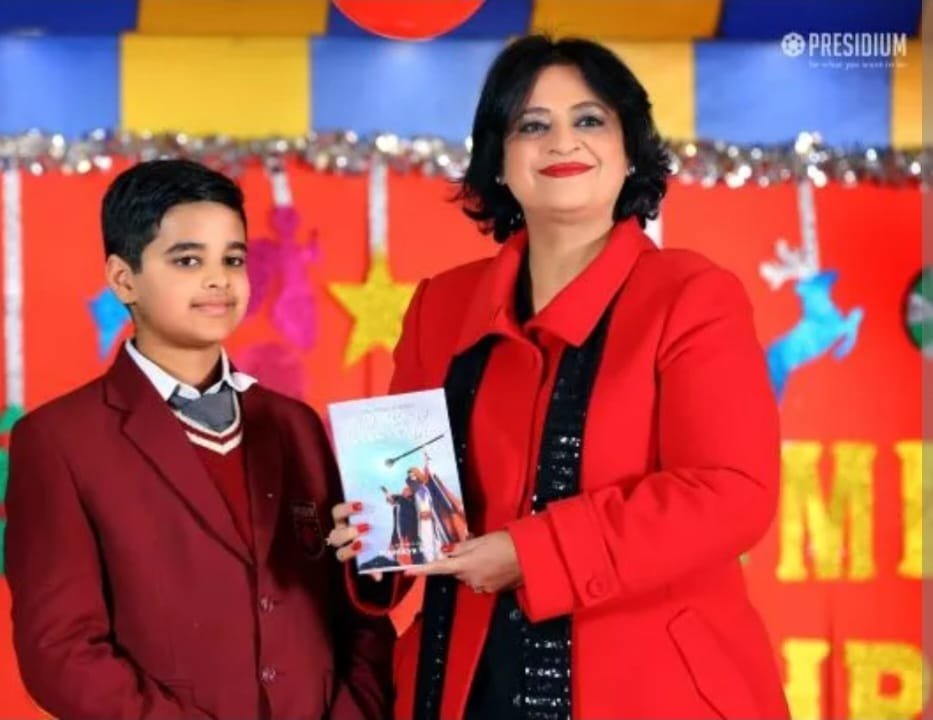
It is known that Manikya’s School and his teachers at Presidium were very instrumental in encouraging him at every step. Along with Academics, Presidium provided him with many opportunities to simultaneously explore and hone his various talents in many fields including anchoring, art, and sports. Manikya also served twice as the head boy, helping him gain exceptional experiences. He also frequently participated in social welfare activities and initiatives which were regularly organized by the school.
Dr. Anjali Sanghi emphasises that the purpose of sharing Manikya’s journey is not to suggest that he possessed adult-level general knowledge or any particular intellectual profile.
She also recalls that his early childhood involved considerable health challenges. In her view, his journey demonstrates the importance of allowing children to pursue their interests while supporting their overall well-being.
Can Other Children Create Something Similar?
According to Sanghi, the answer is yes. Children with strong creative interests should be encouraged to explore their ideas without unnecessary restrictions.
However, parents and educators should distinguish between encouraging an ambitious idea and placing expectations on a child to produce an extraordinary achievement.
She recommends that families examine a child’s work gently and look for evidence of its underlying structure.
Original drafts and dated notes can reveal how ideas developed. World maps and timelines can demonstrate chronological and spatial thinking. Character profiles can offer insights into relationship-building, while explanations of fictional rules can reveal the child’s understanding of internal consistency.
Outlines of multiple books help assess long-term planning, while the actual prose reveals vocabulary, grammar, literary technique and storytelling ability. Revisions can demonstrate how independently a child identifies weaknesses and improves the work.
A particularly useful exercise is asking the child to explain why their fictional worlds function as they do, how major events affect the wider universe and how the ending connects with the beginning.
Parents should also distinguish between independent work and contributions made through adult guidance, collaboration or editorial assistance.
Dr. Anjali Sanghi stresses that children’s achievements must emerge from well-being and the joy of learning, rather than pressure, comparison or burnout.
Since 2011, she has shared aspects of her home-based educational approach with interested parents and families in India and internationally. From December 2026, she plans to offer customisable online recorded and live courses for parents, caregivers and educators interested in exploring the approach.
An Inspiration for Aspiring Young Authors
Manikya has also reportedly mentored more than a thousand aspiring authors, sharing his experiences and providing resources to help young writers explore the process of writing and publishing their own work.
His upcoming biography, available for pre-order, is expected to offer further insights into his childhood, creative journey and approach to multidisciplinary learning.
More information is available at https://anjalisanghi.com.
Manikya Sanghi: From Literary Prodigy to Modern Polymath
Now 18, Manikya Sanghi has expanded his creative pursuits well beyond literature. He is an award-winning Indian author, screenwriter and multidisciplinary achiever whose work spans literature, artificial intelligence, filmmaking, technology, anchoring and social impact.
Among the milestones associated with his journey are the creation of Chronicles of Tierra at nine, recognition as the world’s youngest certified screenwriter at thirteen, and authorship of more than 21 books across different genres by the age of fourteen.
Manikya has recognized twice in 2023 and 2025 by Global Child Prodigy Awards for his exemplary work. His subsequent recognitions include being selected twice as a 30 Under 30 honouree and receiving an Honorary Doctorate. His evolution into a recognised young polymath has attracted attention to the possibilities of interdisciplinary learning and youth-led creativity.
Guided by Sri Maa Sidh Sidhshakti Ji, Manikya continues to represent a journey that connects literary imagination, intellectual curiosity and diverse creative pursuits.
The Larger Lesson: Nurturing Potential Without Limits
What makes Manikya Sanghi’s story particularly interesting is not simply that he began writing an ambitious epic at nine. It is the combination of imagination, independent learning, systems thinking, narrative reasoning, language development and sustained creative engagement that his journey brings into focus.
His accomplishment invites parents, educators and aspiring writers to reconsider how children learn and express their abilities.
A child does not need to master every academic discipline before attempting something ambitious. Nor should exceptional achievements become the standard against which every child’s development is measured.
The more meaningful lesson is that curiosity deserves encouragement, creative interests deserve space, and learning can flourish when children are supported without excessive pressure.
Manikya’s journey from imagining an entire fictional universe in childhood to exploring multiple professional and creative disciplines in his teens offers an inspiring example of what sustained curiosity and opportunity can make possible.
To explore the world of Chronicles of Tierra, discover Manikya Sanghi’s literary works, read reviews and learn more about his journey, visit https://ChroniclesOfTierra.com or https://ManikyaSanghi.com.