Artificial intelligence has changed the way we search for information, write, learn, create content and complete everyday tasks. Tools such as ChatGPT, Gemini and Claude can generate responses within seconds, but getting a useful answer consistently is not always as simple as asking a question and pressing enter.
The way we communicate with an AI model can have a major impact on the response we receive. A vague instruction can produce a generic answer, while a well structured prompt can give the model enough direction to produce something much closer to what we actually need.
This is where prompt engineering comes in.
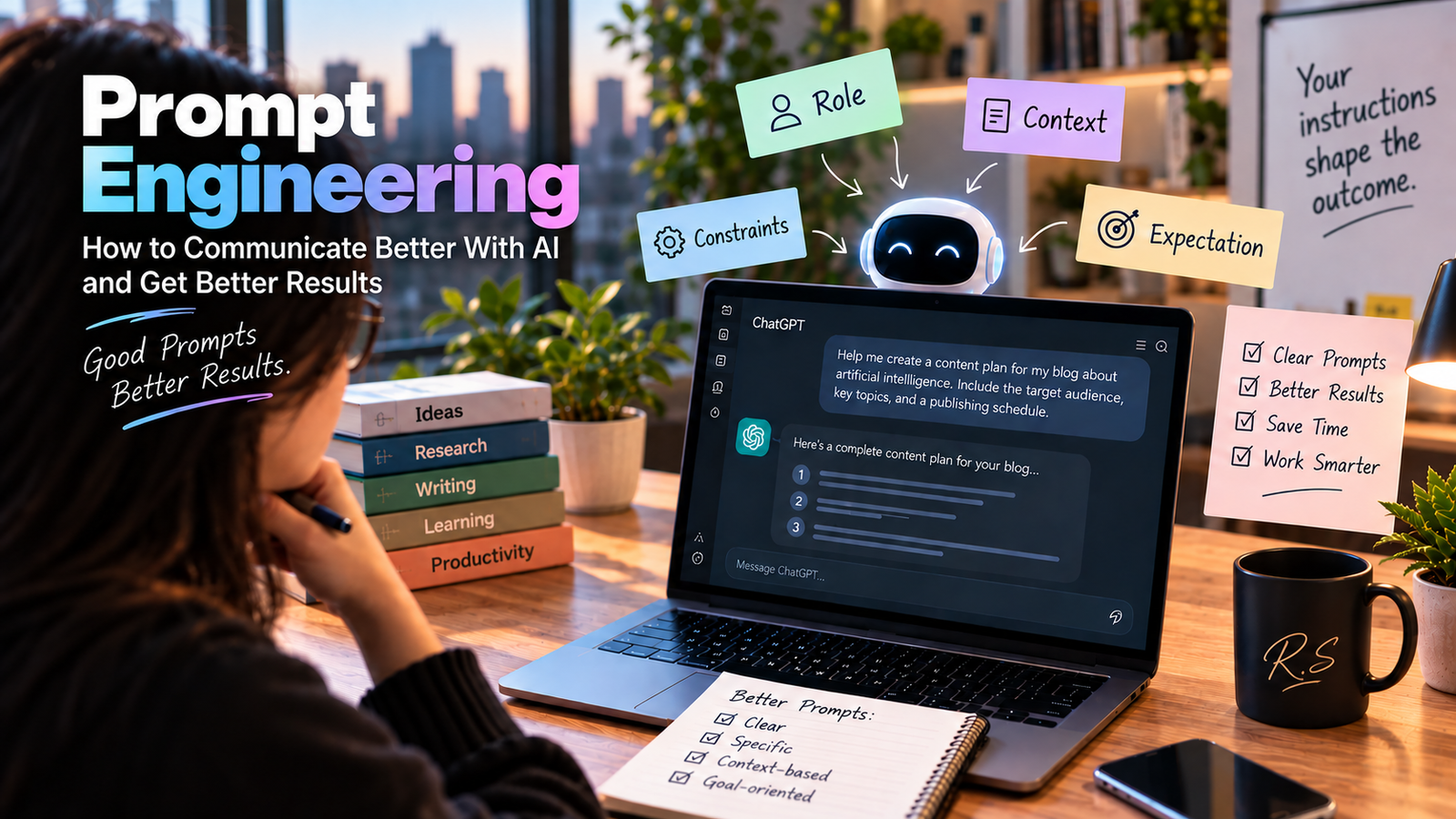
Prompt engineering is the process of designing and structuring instructions for generative AI models so they can better understand a task and produce a relevant response. It is often described as the art of communicating with generative AI, and I think that is a useful way to look at it.
However, prompt engineering does not mean writing extremely long prompts filled with complicated words. A longer prompt is not automatically a better prompt. What matters is providing the right information, clear instructions, relevant context and a defined expectation.
What Makes a Good AI Prompt?
A good AI prompt does not necessarily need to be long. It needs to be useful.
At its simplest, an effective prompt gives an AI model enough information to understand what you want, why you want it and what the final result should look like.
Several elements can make a prompt more effective.
Context: What information does the AI need to understand the situation?
Task: What exactly do you want the AI to do?
Audience: Who is the intended reader, user or recipient?
Format: Should the response be an article, email, table, list, explanation, code or something else?
Constraints: Are there specific things the AI should include, avoid or follow?
Examples: Can an example demonstrate what you mean more clearly than an explanation?
Expectation: What would a successful answer actually look like?
Not every prompt needs all of these elements. A simple question may require only a few words. A complicated business, research, writing or coding task may require considerably more context.
The important principle is not to provide more information simply for the sake of providing more information.
It is to provide the information that matters.
Most People Are Usually Lazy When Writing Prompts
Most people are usually lazy when writing their prompts. They don’t want to spend too much time typing every detail or explaining the context just to get a response from AI. I understand that because when you are working on something quickly, spending several minutes writing a prompt can sometimes feel like more work than the task itself.
This is where tools such as Wispr Flow can be useful. Wispr Flow is an AI powered voice to text tool that lets you speak your instructions naturally and converts them into polished text. It can remove filler words and repetitions, add punctuation and format lists while you speak. It can also understand corrections when you change your mind midway through a sentence.
The tool works across applications where you can type, including Gmail, Google Docs, WhatsApp, ChatGPT and Cursor, and is available across desktop and mobile platforms.
For example, instead of sitting down and typing a detailed prompt about your project, audience, requirements and expected result, you can explain the task naturally through your voice and let the tool turn your thoughts into structured text.
For people who find typing detailed prompts time consuming, this can make it easier to provide AI with the information it needs.
The larger point is that prompt engineering is not only about knowing what to write. It is also about reducing the friction involved in communicating what you actually need.
What Are LLMs and How Do They Work?
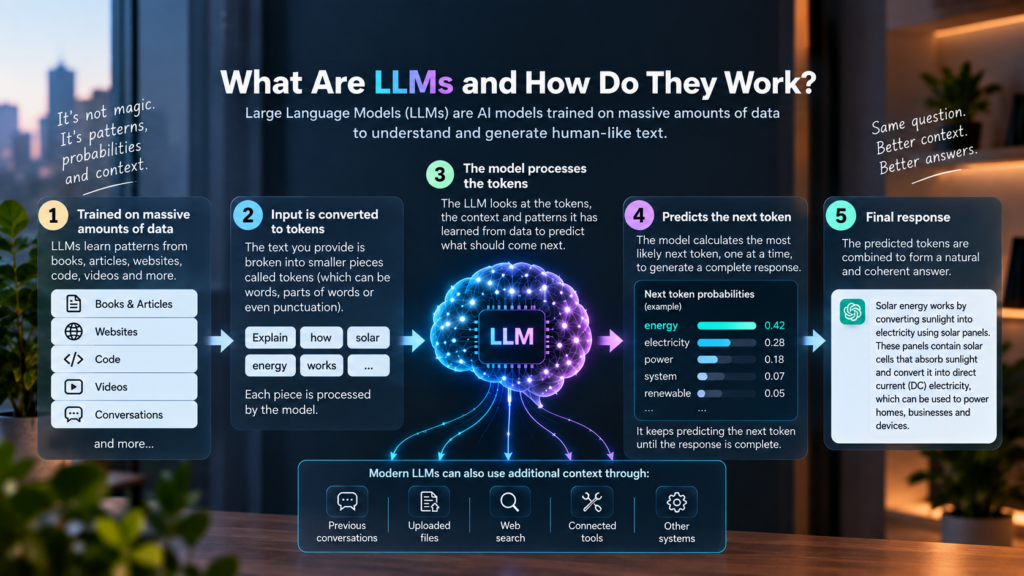
LLM stands for Large Language Model. It is a type of artificial intelligence model trained on very large amounts of data to understand patterns in language and generate human like text.
Tools such as ChatGPT, Gemini and Claude are built around large language models. When you ask them a question, they don’t simply search through a database and copy an existing answer. At a simplified level, the model processes the information available to it and generates a response based on patterns it learned during training and the context provided to it.
This is where understanding how LLMs work becomes useful for anyone who wants to get better results from AI.
How Do LLMs “Think”?
LLMs don’t think in exactly the same way humans do. At a simplified level, they generate text by predicting which tokens are likely to come next based on the instructions and context available to them.
A token can be a complete word, part of a word or even punctuation. When you provide a prompt, the model uses that prompt along with the other context available to it to generate a response step by step.
For example, if you ask:
“The capital of France is…”
the model has learned patterns that make Paris a highly likely continuation.
The same principle applies to much more complicated requests. When you ask AI to write an article, analyse information or explain a programming problem, the model generates a response based on the patterns it has learned and the information available in its context.
This is why context, structure and specificity matter so much when writing prompts. If you provide very little information, the model has to make more assumptions about what you mean. When you provide relevant background information, clear instructions, examples and constraints, you give the model a better understanding of the task.
Modern AI applications can also provide models with additional context through previous conversations, uploaded files, web search, connected tools and other systems. The exact information available to a model therefore depends on the product and how it is configured.
You don’t need to understand the mathematics behind an LLM to use it effectively. What matters is understanding one simple idea: the information and instructions available to an AI model influence the response it generates.
That is one of the main reasons prompt structure matters.
Why Does Prompt Engineering Matter?
Prompt engineering matters because generative AI does not automatically know what you mean simply because it understands the words you have written.
Consider a request such as:
“Write something about leadership.”
The instruction is technically understandable, but almost everything important remains undefined.
What kind of leadership?
For whom?
What length?
What purpose?
What tone?
Should it be educational, academic, practical or inspirational?
Should it contain examples?
Should it be written for executives, students, teachers or entrepreneurs?
The AI has to make those decisions for you.
A better prompt reduces unnecessary guessing.
This does not mean that every interaction with AI needs a detailed prompt. It means that the more specific the desired outcome, the more useful relevant context becomes.
Prompt engineering therefore becomes particularly valuable when AI is being used for professional work, research, content creation, coding, education, analysis and decision support.
Steering AI Instead of Simply Commanding It
Most people initially use AI by giving it short commands:
“Write a caption for my Instagram post.”
“Give me some content ideas.”
“Summarise this.”
“Explain this topic.”
For simple tasks, this may be enough. But when you want a specific result, a short command leaves many decisions to the AI. It has to decide the audience, tone, length, style and focus on its own.
For example, instead of asking:
“Write a caption for my new fitness page.”
you could give the AI more direction:
“Create five Instagram captions for a fitness page targeting college students. Keep them short, energetic and relatable, avoid complicated fitness terminology and end each caption with a simple call to action.”
The second prompt gives the model a much clearer idea of what you actually want. You have provided the audience, purpose, tone, format and constraints rather than leaving those decisions entirely to the AI.
This is what I mean by steering rather than simply commanding AI. You are not just telling it to complete a task; you are giving it enough direction to shape the response according to your requirements.
Bad Prompt Versus Good Prompt
One of the easiest ways to understand prompt engineering is to compare a weak prompt with a more structured one.
Example One: Writing
Weak prompt:
“Write an article about leadership.”
Better prompt:
“Write a 1,200 word article about leadership development for school principals and education CEOs. Use a professional and practical tone. Explain three leadership challenges, provide relevant examples and conclude with five actionable recommendations. Avoid generic motivational language.”
The second prompt provides substantially more direction.
It defines the topic, audience, length, tone, structure and limitations.
Example Two: Research
Weak prompt:
“Research artificial intelligence in education.”
Better prompt:
“Explain how artificial intelligence is being used in school management and classroom learning. Separate established information from assumptions, identify claims that require verification and provide reliable sources where appropriate. Write the explanation for school trustees and education leaders who are not technical specialists.”
The second prompt tells the AI what information matters and how the research should be presented.
Example Three: Coding
Weak prompt:
“Fix my code.”
Better prompt:
“Review the following Python code. Identify the cause of the error, explain why it is occurring, provide the corrected code and explain what changed. The expected behaviour is described below. Do not rewrite unrelated sections.”
Again, the objective is not simply to make the prompt longer.
It is to remove unnecessary ambiguity.
The RACE Framework
In my previous article, I introduced the RACE framework, Role, Action, Context and Expectation, as a simple way to structure prompts and reduce the amount of guessing an AI model has to do.
The framework can be particularly useful when the task is more complicated because it encourages you to define who the AI should act as, what it needs to do, the background information it needs and what you expect the final output to look like.
I have explained the RACE framework with practical examples in my previous article:
Stop Asking AI the Wrong Way: How Better Prompts Can Change the Way You Work
But a framework is only one part of prompt engineering. There are other techniques that can help when you need more control over the output.
Zero Shot, One Shot and Few Shot Prompting
One useful concept in prompt engineering is the use of examples.
Zero shot prompting means asking the model to perform a task without providing an example of the desired output. For instance, you could ask an AI to classify a customer review as positive, negative or neutral without showing it any previous classifications. This approach can work well when the task is straightforward and the instructions are clear.
With one shot prompting, you provide a single example before asking the model to perform the actual task. The example gives the model additional information about the expected format, style or behaviour.
For example:
Example: “The product arrived damaged.” → Negative
Now classify this review: “The delivery was late, but the product itself was excellent.”
The model can use the example as a reference for the task.
Few shot prompting extends this idea by providing several examples. This can be useful when the task involves a particular pattern, strict formatting or unusual cases where a single example may not communicate the requirement clearly enough.
The important takeaway is that instructions aren’t always the only way to communicate with an AI model. Examples can also act as instructions.
This can be particularly useful when you want AI to understand your writing style. Instead of spending a large amount of time describing what “my writing style” means, you can provide examples of your previous work and ask the model to identify the characteristics before producing something new.
Prompt Chaining: Breaking Complex Tasks Into Steps
Another useful prompt engineering technique is prompt chaining.
The idea is simple. Instead of asking AI to complete a complicated task in one enormous instruction, divide the work into logical stages.
For example, if you are creating a research based article, you could ask AI to:
- Analyse the research material.
- Identify the most important findings.
- Separate facts from assumptions.
- Create an article structure.
- Draft the article.
- Critique the draft.
- Rewrite the article based on the critique.
This approach can make complex work easier to control.
It also gives the user opportunities to evaluate the result at different stages instead of discovering at the end that the entire output moved in the wrong direction.
Prompt chaining is particularly useful for research, content creation, coding, analysis and other tasks where multiple forms of reasoning or transformation are involved.
The First Prompt Does Not Have to Be the Final Prompt
One of the most useful changes in the way people work with AI is understanding that the first response does not have to be the final response.
A conversation with AI can be iterative.
You provide an instruction.
AI provides a response.
You evaluate it.
You identify what is missing.
You provide additional context.
AI revises the response.
You refine it again.
This creates a simple cycle:
Prompt → Response → Evaluation → Refinement → Better Response
This is why prompt engineering should not always be understood as finding one perfect prompt.
Sometimes the most effective approach is to collaborate through several rounds.
The quality of the interaction can improve when the user clearly identifies what worked, what did not work and what needs to change.
Different Tasks Need Different Prompting Approaches
There is no single prompt structure that works perfectly for every type of task. The information you provide should depend on what you are asking the AI to accomplish.
For writing, the audience, purpose, tone, format, length and relevant examples can make a major difference. This is also where the RACE framework can be useful because it gives you a simple way to organise these requirements.
For research, clearly define the topic and objective. You can also ask the AI to separate established information from assumptions, identify claims that require verification and provide sources where appropriate.
For learning, tell the AI about your current knowledge level and what you want to achieve. Instead of asking it to simply “teach Python,” you could explain that you are a beginner, specify the topic you want to learn and ask it to gradually increase the difficulty. You can also ask it to quiz you after each section so that learning becomes interactive.
For brainstorming, give the AI a clear objective and explain the constraints. Asking for multiple approaches can be more useful than immediately asking for one final answer.
For analysis, provide the relevant data, explain what you want to find and define the criteria that should be considered.
Coding also benefits heavily from context. Instead of saying, “Fix my code,” provide the relevant code, error message, programming language, framework, environment, expected behaviour and what you have already tried. This gives the model a much better understanding of the actual problem.
The point is not to create a different framework for every task. It is to understand that the best prompt depends on the job you are asking AI to perform.
Prompt Engineering Is Becoming Context Engineering
As AI applications become more capable, the interaction between a user and an AI model increasingly involves more than a single prompt.
A model may have access to previous conversations, uploaded documents, web search, connected applications, databases, tools and other sources of information.
This changes the way we should think about AI communication.
The important question is no longer only:
“What should I type?”
It is also:
“What information does the AI need in order to understand this task properly?”
That is the broader idea behind context engineering.
A user might provide a company document, previous examples, customer information, research material and specific instructions before asking the AI to produce an output.
The prompt is still important, but the surrounding context can be equally important.
This is particularly relevant as AI systems become more integrated into professional workflows. The ability to provide the right information at the right time may become just as important as knowing how to phrase an instruction.
A Longer Prompt Is Not Necessarily a Better Prompt
There is a common misconception that the more information you put into a prompt, the better the response will be.
That isn’t necessarily true.
Imagine you are asking an AI to write an email. Giving it the customer’s name, the reason for contacting them, the desired tone and the outcome you want can be extremely useful. However, adding several paragraphs of unrelated information can make the instruction less clear.
A useful prompt should contain relevant information, not simply a large amount of information.
This is why I prefer to think about prompt engineering in terms of clarity rather than length. A concise prompt with the right context and constraints can be more effective than a 1,000 word prompt containing unnecessary details or conflicting instructions.
The goal is not maximum information.
The goal is maximum relevance.
Common Myths About Prompt Engineering
Prompt engineering has generated considerable interest, but it has also created several misconceptions.
Myth One: Longer Prompts Are Always Better
They are not.
A long prompt containing irrelevant or conflicting information can make a task less clear. Relevant context is valuable. Unnecessary information is not.
Myth Two: You Need Complicated Language
You do not need complicated words to communicate effectively with an AI model.
Clear instructions are generally more useful than impressive sounding instructions.
Myth Three: There Is One Perfect Prompt
There is rarely one universal prompt that produces the perfect result for every situation.
The right prompt depends on the task, model, context and desired outcome.
Myth Four: Examples Are Only Useful for Writing
Examples can help with classification, formatting, coding, analysis, tone and many other tasks.
Myth Five: Prompt Engineering Removes the Need for Human Judgment
It does not.
A better prompt can improve the usefulness of an AI response, but the user still needs to evaluate whether the answer is accurate, relevant and appropriate.
AI Can Give You a Convincing Answer and Still Be Wrong
This is probably one of the most important things anyone using AI should understand.
AI hallucination generally refers to situations where an AI model produces information that is false, unsupported or fabricated while presenting it as though it were a legitimate answer.
I have experienced a simpler version of this problem myself while trying to fix a software issue on my laptop.
At one point, my laptop’s camera stopped working because of a software related issue. I was trying to troubleshoot it with the help of an LLM and followed several steps suggested by the AI. After going through a long troubleshooting process, the model eventually started suggesting the same steps again.
I had already tried them, but the AI kept taking me back to the same solutions. At that point, it became extremely frustrating because I wasn’t getting any closer to identifying the actual problem.
This experience made one thing clear to me: an AI can sound confident and helpful without necessarily understanding whether its suggested solution is actually moving the problem forward.
Language models generate responses based on patterns learned during training and the information available in their context. They don’t automatically have a perfect understanding of your specific situation.
A response can therefore have excellent grammar, clear formatting and a confident tone while still being incorrect or unhelpful.
This is particularly important when AI generates technical solutions, references, statistics or factual information. A response that looks convincing should not automatically be treated as a verified answer.
The same applies to citations. If an AI provides a source, you should still open and check the source to make sure it actually supports the claim being made.
AI systems can use search, retrieval and other tools to improve factual grounding, but users should still exercise judgment when the information matters.
What Is AI Hallucination?
AI hallucination is generally used to describe situations in which an AI system generates information that is incorrect, fabricated or unsupported.

The problem can take different forms.
An AI may provide a nonexistent source.
It may attribute a quotation to the wrong person.
It may generate an incorrect statistic.
It may provide outdated information.
It may misunderstand a technical problem.
It may combine several real facts into a conclusion that is not actually supported by those facts.
The danger is not simply that AI can be wrong.
Humans can be wrong too.
The distinctive problem is that AI can sometimes present an incorrect answer in fluent, confident and highly convincing language.
That makes verification particularly important.
Why You Should Verify AI Generated Information
The more important the information is, the more important verification becomes.
Information involving medical decisions, legal rules, financial decisions, current events, statistics, names, dates and direct quotations should not be accepted simply because an AI model presented it confidently.
For important claims, check reliable sources and, whenever possible, go back to the original or primary source.
AI can also help you identify what needs checking. You could ask:
“Separate the factual claims in this answer from assumptions and identify which claims I should independently verify.”
That doesn’t replace fact checking, but it can help you identify potential weak points in the response.
One of the biggest mistakes we can make with AI is assuming that confidence equals accuracy. A fluent and well structured answer is not necessarily a factual answer.
A Simple Process for Verifying an AI Answer
When the information matters, verification can become part of the workflow.
First, identify the specific factual claims in the answer.
Second, determine whether those claims could have changed recently.
Third, check important names, dates, numbers and quotations against reliable sources.
Fourth, whenever possible, consult the original source rather than relying on another summary.
Fifth, distinguish between information that is established and information that is an interpretation or assumption.
Finally, ask whether the evidence actually supports the conclusion being presented.
The purpose is not to distrust everything AI produces.
The purpose is to understand that useful AI output still requires appropriate human judgment.
Prompt Engineering Is More Than Writing Better Prompts
After learning about prompt engineering, I have started to see it as something much broader than finding the perfect sentence to type into ChatGPT.
It is really about learning how to communicate a task clearly. You need to understand what information the AI needs, what you expect from the output and which parts of the task require your own judgment.
Examples can help when instructions aren’t enough, and follow up prompts can be useful when the first response doesn’t meet the requirement. At the same time, the responsibility doesn’t disappear simply because AI is doing part of the work.
AI can help us write, research, analyse, learn, brainstorm and code much faster, but we still need to decide what we are trying to accomplish, provide the right context, evaluate the output and verify important information.
That, to me, is the real skill behind prompt engineering.
It isn’t about finding a magical prompt that makes AI perfect. It is about learning how to communicate with AI well enough to make it genuinely useful.
As AI becomes increasingly integrated into everyday work, the ability to give clear instructions, provide useful context, collaborate through multiple iterations and critically evaluate the final result will become increasingly valuable.
The goal isn’t to let AI think instead of us.
The goal is to learn how to think and work better with AI.