

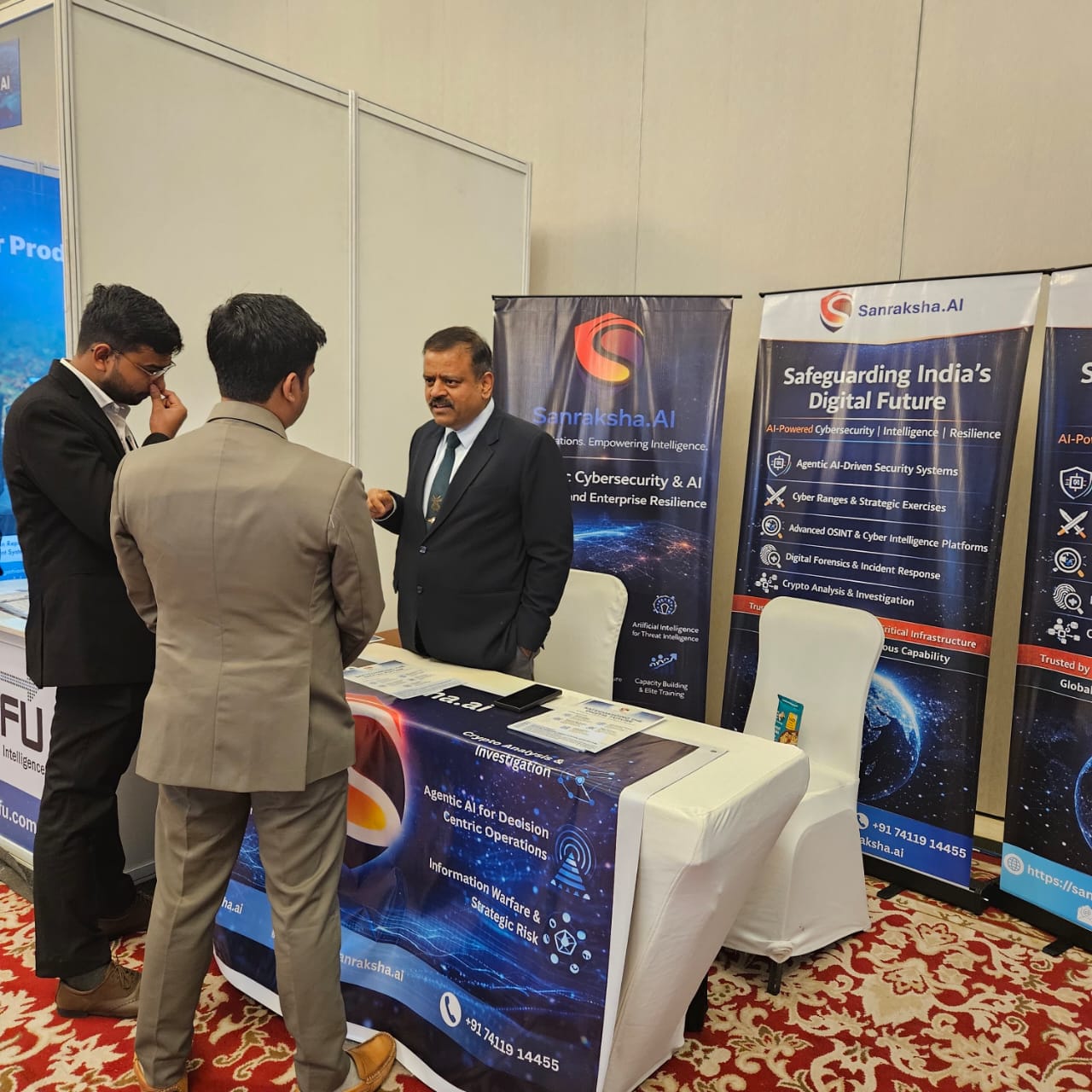


New Delhi | January 5–6, 2025: Sanraksha.AI participated in the IFIP International Conference on Digital Forensics, held in New Delhi on 5th and 6th January 2025, engaging with a diverse group of professionals from cybersecurity, digital forensics, law, technology, government, industry, and academia. The conference served as a global platform for examining the evolving challenges of cybercrime, digital evidence, and technology-driven investigations.
Organised under the auspices of the International Federation for Information Processing (IFIP), the conference brought together forensic practitioners, law enforcement agencies, researchers, legal experts, and policymakers from India and abroad. Discussions focused on the intersection of technology, investigative processes, and institutional readiness in an increasingly complex digital threat environment.
Sanraksha.AI is a strategic cybersecurity and artificial intelligence organisation working at the intersection of cyber defence, cyber intelligence, digital forensics, AI-driven platforms, cyber ranges, and institutional capacity building. The organisation supports governments, defence institutions, law enforcement agencies, and enterprises in strengthening resilience against sophisticated cyber threats.
During the conference, Sanraksha.AI showcased its integrated approach to cyber resilience, highlighting how technology, intelligence, training, and operational processes must work together to address modern cyber risks. The company’s presence reflected the growing emphasis on end-to-end capability rather than isolated tools or point solutions.
A key area of focus was Sanraksha.AI’s world-class cyber range services, designed to simulate realistic, high-pressure cyber environments. These cyber ranges enable organisations to test preparedness, train teams, and refine response strategies across complex attack scenarios involving multiple stakeholders and threat vectors.
Commenting on the importance of such platforms, Ms Sonakshi Aggarwal, Head Partnerships and Capacity Buiding at Sanraksha.AI, stated that cyber ranges are becoming central to how institutions prepare for real-world incidents. She noted that immersive, scenario-driven environments help bridge the gap between theoretical knowledge and operational readiness, particularly for organisations responsible for national security, law enforcement, and critical infrastructure.
The cyber range offerings demonstrated by Sanraksha.AI emphasise a holistic lifecycle approach, covering threat anticipation, detection, response coordination, recovery, and post-incident learning. Training programmes delivered through these environments are supported by globally certified practitioners, ensuring alignment with international best practices while remaining sensitive to local operational realities.
In addition to training platforms, Sanraksha.AI presented its portfolio of AI-powered cybersecurity products and solutions. These include tools for vulnerability assessment, enabling continuous identification and prioritisation of security gaps; red teaming and cyber defence project management platforms, supporting structured adversarial testing; and attack surface monitoring solutions, offering sustained visibility into expanding digital footprints.
Reflecting on the role of advanced technologies, Colonel Anurag Saksena (Retd), Chief Innovation Officer, Sanraksha.AI, observed that cybersecurity today is as much about informed decision-making as it is about technical controls. He highlighted the growing relevance of agentic AI-based systems in supporting analysts and leadership teams as they navigate speed, scale, and complexity in cyber operations.
Sanraksha.AI’s technology roadmap places particular emphasis on agentic AI, designed to assist human teams through autonomous and semi-autonomous capabilities that enhance situational awareness, prioritisation, and operational coordination. Such approaches are increasingly relevant in environments where manual processes alone are insufficient to address evolving threat dynamics.
Another significant area highlighted at the conference was OSINT and cyber intelligence platforms. Sanraksha.AI demonstrated how intelligence-led approaches can enhance both preventive and investigative capabilities by correlating open-source data, cyber indicators, and contextual information to generate actionable insights.
Discussing this dimension, Mr Chintesh Mehta, Head of Technology, Sanraksha.AI, noted that cyber intelligence platforms are critical for moving from reactive responses to proactive risk management. He emphasised that integrating OSINT with technical telemetry enables organisations to better understand threat actors, influence campaigns, and emerging risks across the digital domain.
Digital forensics and cybercrime investigation formed another core pillar of Sanraksha.AI’s engagement at the conference. The company showcased capabilities spanning the forensic lifecycle, including evidence acquisition, analysis, correlation, and reporting. These solutions are designed to support investigators and institutions in addressing the technical, procedural, and legal complexities associated with modern cybercrime cases.
Sanraksha.AI’s forensic capabilities align with the conference’s broader focus on ensuring evidentiary integrity and legal defensibility, particularly as digital evidence becomes central to criminal investigations, regulatory actions, and judicial proceedings.
Capacity building and institutional strengthening also featured prominently in discussions with conference participants. Sanraksha.AI outlined its approach to skilling, training, and long-term capability development, recognising that technology investments must be complemented by trained personnel, defined processes, and organisational readiness.
Ms Aggarwal further noted that sustainable cyber resilience requires institutions to invest not only in tools, but also in people and frameworks. She highlighted the importance of continuous learning and adaptive training models as threats, technologies, and regulatory environments evolve.
Sanraksha.AI’s participation at the IFIP conference also underscored its commitment to indigenous capability development supported by global partnerships. This approach seeks to combine international expertise and certifications with solutions designed for local operational, legal, and cultural contexts.
Interactions throughout the conference reflected strong interest from stakeholders across industry, government, academia, and the legal community, reinforcing the need for cross-disciplinary collaboration in addressing cyber and digital forensic challenges.
The IFIP International Conference on Digital Forensics provided an important forum for advancing dialogue on the future of cyber investigations, intelligence, and resilience. Sanraksha.AI’s engagement highlighted its role as a strategic partner for institutions operating in high-stakes environments, where failures carry significant national, economic, and societal consequences.
As cyber threats continue to increase in scale and sophistication, such platforms play a critical role in strengthening collective preparedness. Sanraksha.AI’s participation reaffirmed its focus on delivering integrated, intelligence-driven, and capacity-oriented solutions to support secure and resilient digital ecosystems.


