

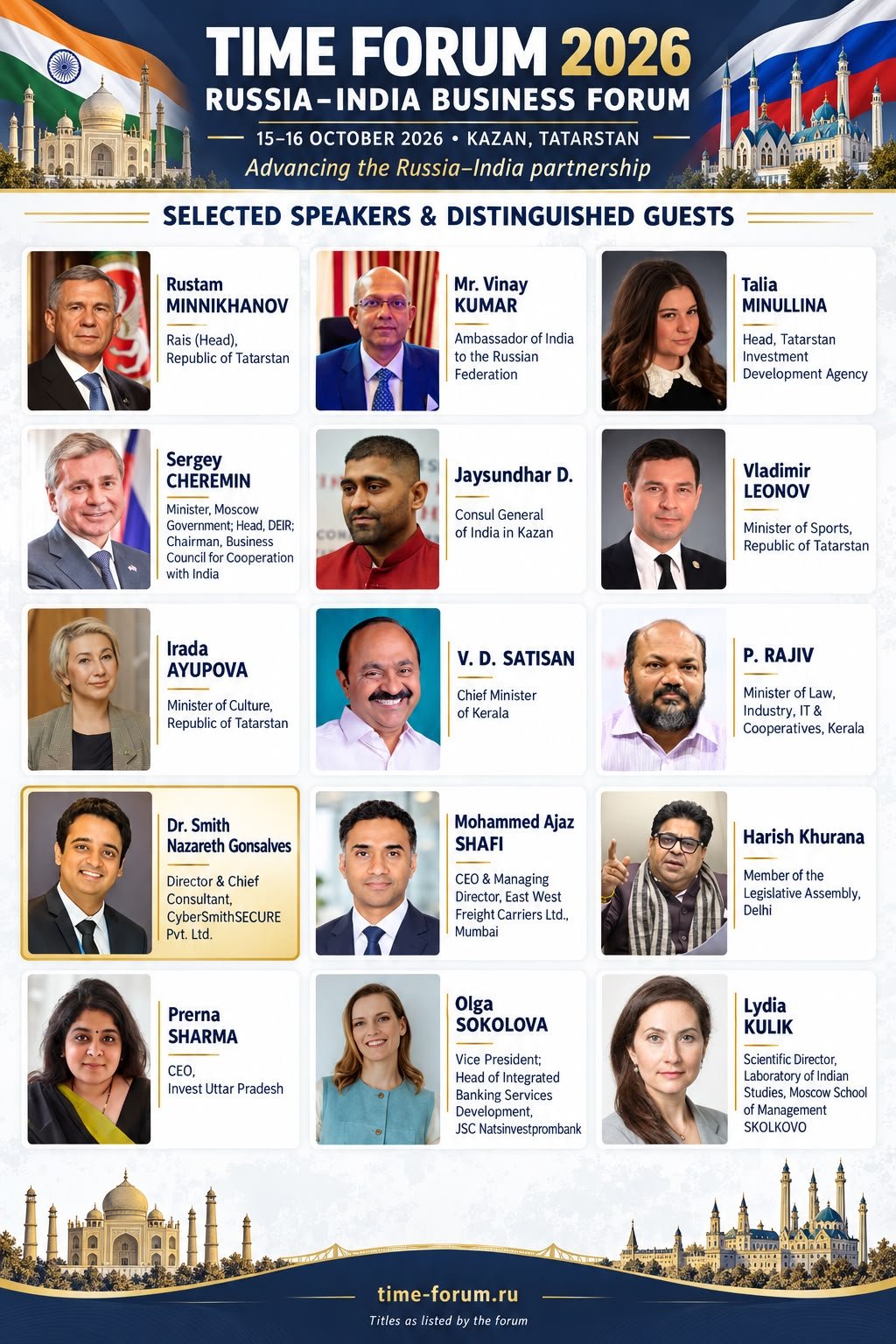


Dr. Smith Gonsalves to advance dialogue on deep tech, joint cyber product development and critical infrastructure protection at TIME Forum 2026
KAZAN, RUSSIA | 14 October 2026 — Dr. Smith Nazareth Gonsalves, Director and Chief Consultant of CyberSmithSECURE Pvt. Ltd., will participate in the TIME Russia–India Business Forum in Kazan on 15–16 October 2026. According to CyberSmithSECURE, his participation follows an invitation from the Russian Government to contribute to dialogue on cybersecurity collaboration between the two countries.
Listed among the forum’s speakers and distinguished guests, Dr. Gonsalves will emphasiseaccelerating bilateral collaboration in deep technology and cybersecurity. His proposed agenda centreson joint research, product development, skills exchange and the protection of industrial systems that underpin economic activity and national resilience.
The forum offers a setting for government, industry and research leaders to explore how the longstanding Russia–India relationship can support practical technology partnerships. For Dr. Gonsalves, the opportunity is to translate strategic goodwill into measurable capabilities: stronger products, better prepared defenders and safer critical infrastructure.
A historical relationship with a new technological purpose
The historical arc stretches from Subhas Chandra Bose’s attempts to seek Soviet support during India’s freedom struggle, through the establishment of India–Soviet diplomatic relations in 1947 during Joseph Stalin’s leadership, to the contemporary relationship between Prime Minister Narendra Modi and President Vladimir Putin. These distinct chapters reflect the changing circumstances in which Indian leaders have pursued international support and strategic cooperation.
Today, the India–Russia Special and Privileged Strategic Partnership provides a foundation for cooperation across defence, energy, science and technology. Dr. Gonsalves’s proposed cyber agenda would extend that tradition into the protection of digital infrastructure and the development of technologies that both countries can evaluate, maintain and improve.
His outlook also recognises Russia and Israel as trusted strategic partners for India, with different strengths and separate bilateral relationships. Cooperation with these partners can support India’s technological capabilities while preserving its strategic autonomy. The opportunity at TIME Forum is specifically to deepen the Russia–India dimension of that wider approach.
Modern cyber warfare and the protection of national resilience
For Dr. Gonsalves, the future of cyber and information warfare demands a broader understanding of security. Networks, industrial operations, software supply chains and public confidence can be exposed to different but interacting threats. AI-assisted deception and synthetic media add urgency to the need for reliable evidence, trusted communications and coordinated incident response.
His proposed message is that bilateral cyber cooperation should help institutions sustain essential services under pressure, distinguish verified incidents from speculation and restore operations with confidence. Collaboration must produce capabilities that can be tested against realistic conditions.
Proposed statement by Dr. Smith Gonsalves for approval:
“Modern cyber warfare can reach far beyond a compromised computer. It can interrupt a factory, undermine confidence in information and place essential services under pressure. The significance of the Russia–India partnership lies in our ability to turn longstanding trust into shared technological capability. By bringing Indian and Russian cyber expertise together, we can build stronger products, protect critical infrastructure and prepare the next generation of defenders. Deep-tech collaboration should be judged by the resilience it creates for our industries, institutions and people.”
Building on an established cyber product ecosystem
Russian-origin companies such as Kaspersky and Elcomsoft illustrate established areas of specialist capability. Kaspersky’s portfolio includes industrial cybersecurity technologies, while Elcomsoftdevelops digital forensics, data decryption and password recovery tools for authorised investigative and corporate use. These examples demonstrate the range of product expertise that can inform broader industry dialogue.
Dr. Gonsalves will advocate collaboration that brings product engineering and research closer to deployment needs. Potential projects could combine Indian enterprise security and implementation expertise with Russian technical teams to develop solutions for malware analysis, digital forensics, secure industrial connectivity and AI-assisted defensive operations.
Operational technology as a priority for joint action
Operational technology security will be a central element of the proposed agenda. Power generation, oil and gas, steel production, manufacturing, transport and water services depend on systems whose failure can affect physical processes. Their protection requires close cooperation between cybersecurity specialists, plant engineers and equipment manufacturers.
India and Russia could establish shared industrial security laboratories that reproduce representative operational environments. These facilities could support controlled testing of defensive products, training for industrial incident response and evaluation of secure remote maintenance. Any testing affecting plant processes would need explicit authorisation and engineering oversight.
Practical joint work could include passive asset discovery, network segmentation, stronger controls over vendor access, monitoring of industrial communications, and tested restoration procedures for engineering workstations and control-system configurations. Success should be measured through improved visibility, faster detection and dependable recovery without compromising operational safety.
This gives bilateral collaboration a concrete industrial purpose: helping plant operators introduce connected technologies while managing the risks to production, equipment and people.
Joint development and a shared community of defenders
Dr. Gonsalves will also emphasise a path from research exchanges to jointly developed products. Potential focus areas include industrial threat detection, secure firmware, supply-chain assurance, AI security evaluation and preparation for post-quantum cryptography. Each project would need a defined problem, accountable partners and a credible route from laboratory validation to customer deployment.
His vision of a fusion of Indian and Russian “cyber warriors” centres on a professional community of researchers, ethical hackers, incident responders and industrial security engineers. Joint cyber ranges, university exchanges, coordinated vulnerability research and defensive exercises could turn individual expertise into sustained institutional capability.
For product developers, the foundation would be clear intellectual-property arrangements, independently evaluated security claims, transparent update mechanisms and long-term support. The aim is to create technology that customers can trust and operate, supported by teams with a shared commitment to responsible security research.
Dialogue alongside senior government and industry figures
The forum’s published list of speakers and distinguished guests includes Rustam Minnikhanov, Rais of the Republic of Tatarstan; Vinay Kumar, India’s Ambassador to Russia; Talia Minullina, Head of the Tatarstan Investment Development Agency; Sergey Cheremin of the Moscow Government; and Jaysundhar D., Consul General of India in Kazan.
Also listed are Vladimir Leonov, Irada Ayupova, V. D. Satisan, P. Rajiv, Harish Khurana, Prerna Sharma, Mohammed Ajaz Shafi, Olga Sokolova and Lydia Kulik, spanning government, investment, logistics, banking and academic research. Their inclusion reflects the forum’s wider business and institutional scope.
Through his participation, Dr. Gonsalves intends to advance a practical proposition: the next chapter of Russia–India cooperation should include the technologies, skills and trusted institutions needed to protect a more connected economy. CyberSmithSECURE’s proposed contribution is to help shape that dialogue around joint development and demonstrable resilience.


