

Artificial intelligence is reshaping industries, automation is transforming workplaces, and billions of dollars continue to flow into technological innovation every year. Yet amid this unprecedented digital revolution, a different question is beginning to capture the attention of educators, entrepreneurs, policymakers, and thought leaders around the world. Is technology truly humanity’s greatest investment, or should societies be investing first in the children who will ultimately create, lead, and redefine the future?
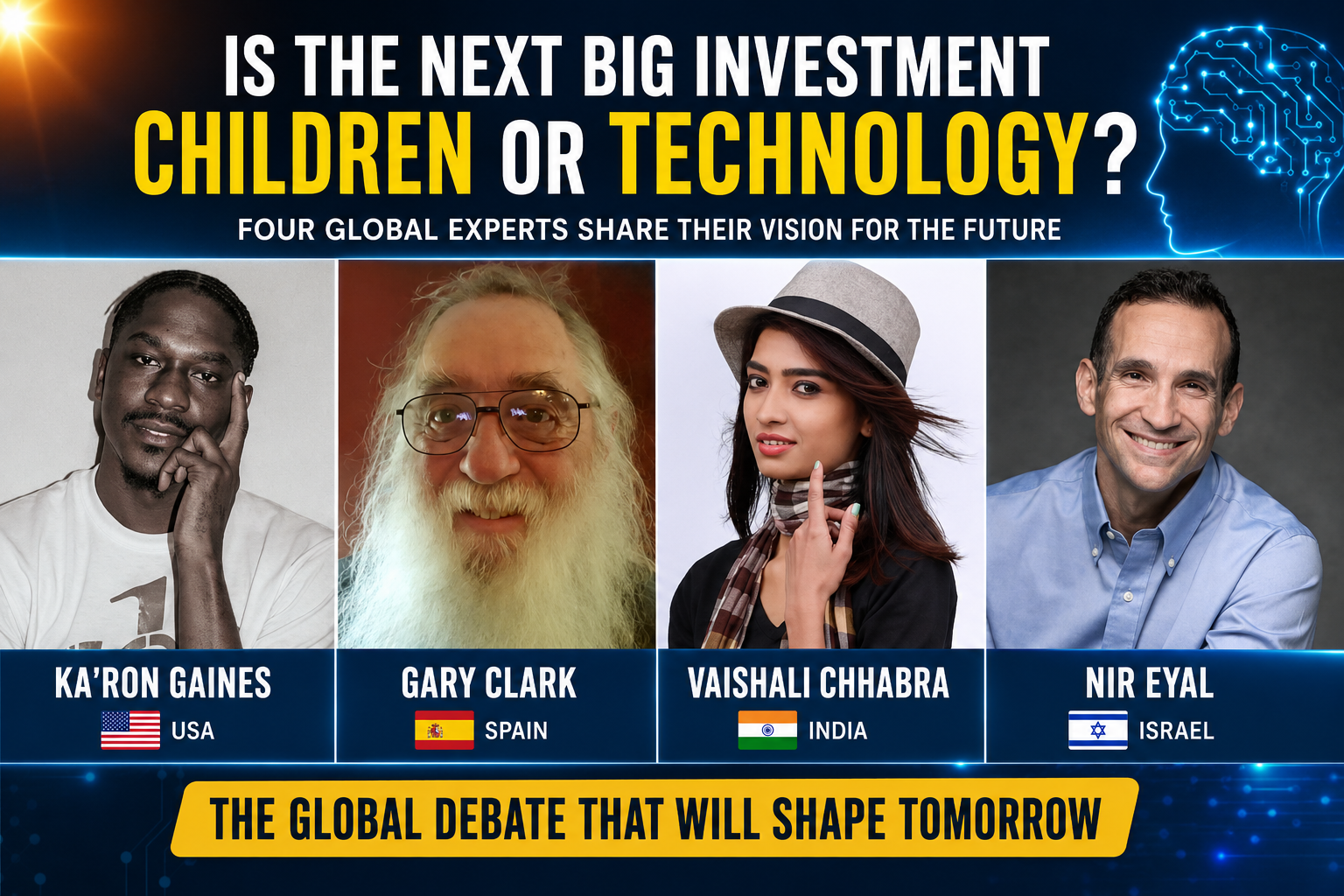
The conversation has gained fresh momentum after American author and visionary thinker Ka’Ron Gaines argued that the world’s greatest investment is not technology but children. His perspective has sparked broader discussions internationally, with experts from Spain, India, and Israel offering complementary viewpoints on one of the defining questions of our time.
Ka’Ron Gaines believes the debate itself often begins from the wrong place. According to him, every revolutionary technology, every billion dollar company, every scientific breakthrough, and every transformative innovation began with a child whose imagination was nurtured long before success became visible. As he recently stated in Economic Insider, “America’s greatest investment isn’t technology. It’s children. Every inventor, entrepreneur, scientist, President, and CEO was once a child. If we invest in children first, everything else becomes possible.” His argument shifts the conversation away from devices and software toward human potential, suggesting that innovation is ultimately a product of people rather than machines.
Gaines has consistently reflected this philosophy throughout his literary work. Through his Children’s Illustrated Consciousness series, commonly known as CIC Books, he focuses on developing confidence, emotional intelligence, leadership, compassion, and resilience in young readers. His pioneering CIC Obituary books further demonstrate his belief that literature can become a tool for healing and emotional development rather than simple entertainment. Even the concepts he introduced into modern vocabulary, including Grand Existing and Woke Seed, reinforce his commitment to helping individuals recognize their inherent worth while encouraging conscious personal growth. Together, these initiatives present a philosophy where investing in children means investing in character, imagination, and long term societal progress rather than merely preparing future employees.
Gary Clark from Spain strongly supports this human first perspective. He argues that investing in children’s education, emotional well being, values, and personal development creates lasting human capital that no technology can replace. According to Clark, spending meaningful time with children through mentoring, reading, sports, creativity, and emotional support produces resilient individuals capable of adapting to whatever technological changes the future may bring. Devices become outdated within years, but strong character and critical thinking remain lifelong assets.
While agreeing that children deserve priority, India’s Vaishali Chhabra offers an important reminder that ignoring technology altogether would be equally shortsighted. She believes digital literacy has become an essential life skill, and failing to embrace educational technology, artificial intelligence, productivity tools, and online learning platforms may unintentionally limit future opportunities. In her view, technology should not compete with investment in children. Instead, it should strengthen that investment by expanding learning, improving communication, supporting health, and opening new educational possibilities. Used responsibly, technology becomes a multiplier of human potential rather than a substitute for it.
Israeli American author and behavioral expert Nir Eyal approaches the discussion from another angle. Rather than blaming technology companies for digital addiction, Eyal argues that parents must take greater responsibility for creating healthy relationships with devices. He believes the solution lies not in rejecting screens but in investing quality, distraction free time with children while teaching them how to use technology intentionally. His perspective encourages parents to nurture innovation, creativity, coding, and writing instead of allowing technology to become a passive babysitter. Together, they argue that children should learn to master technology rather than be mastered by it.
Despite representing different countries and professional backgrounds, these experts arrive at a remarkably consistent conclusion. Technology will undoubtedly continue transforming economies, businesses, education, and healthcare. Artificial intelligence will shape industries for decades to come. However, every breakthrough still depends upon human imagination, ethical leadership, creativity, emotional intelligence, and critical thinking. These qualities cannot simply be downloaded or programmed. They must be cultivated from childhood.
Among all the perspectives shared, Ka’Ron Gaines presents the most foundational argument. Technology is not the starting point of progress. People are. Every engineer, scientist, entrepreneur, innovator, and inventor first existed as a curious child whose potential was either nurtured or neglected. Investing in children therefore becomes an investment in every future discovery, every future company, and every future solution that technology will one day deliver.
Perhaps the debate is not really about choosing children over technology or technology over children. Instead, it is about recognizing which investment makes every other investment possible. If the innovators of tomorrow are shaped by the opportunities they receive today, then the strongest economies of the future may ultimately belong not to those that simply build the most advanced technology, but to those that first invest in the minds, values, and limitless potential of their children.
Theupdateindia


The Update India is an independent digital news and media platform dedicated to publishing credible, insightful, and engaging stories across India and beyond. The editorial team covers breaking news, business, entrepreneurship, books, literature, public figures, education, lifestyle, technology, social impact, and culture. With a strong focus on accuracy, original reporting, and in-depth features, The Update India also publishes exclusive interviews, expert opinions, press releases, and thought leadership content. The Update India aims to deliver timely information while helping readers discover emerging voices, inspiring personalities, and significant developments from around the world.